Most advice on sustainable branding is wrong. It tells you to start with mission language, swap in nicer packaging, post a few factory photos, and hope buyers reward you for being a good person.
They won't.
When I look at brands that last, I don't see sustainability working as a vibe. I see it working as a trust system. You either have proof that survives scrutiny, or you have decoration. That's the game in building a sustainable brand.
The upside is real when you do it right. Sustainable products accounted for 44% of CPG growth from 2013 to 2025, and branded products marketed as sustainable reached 25.4% market share in 2025 according to the NYU Stern Sustainable Market Share Index summary. Buyers will also pay more when they believe you. The problem is belief. Consumers are skeptical, and they should be.
Why Most Sustainable Brands Stall
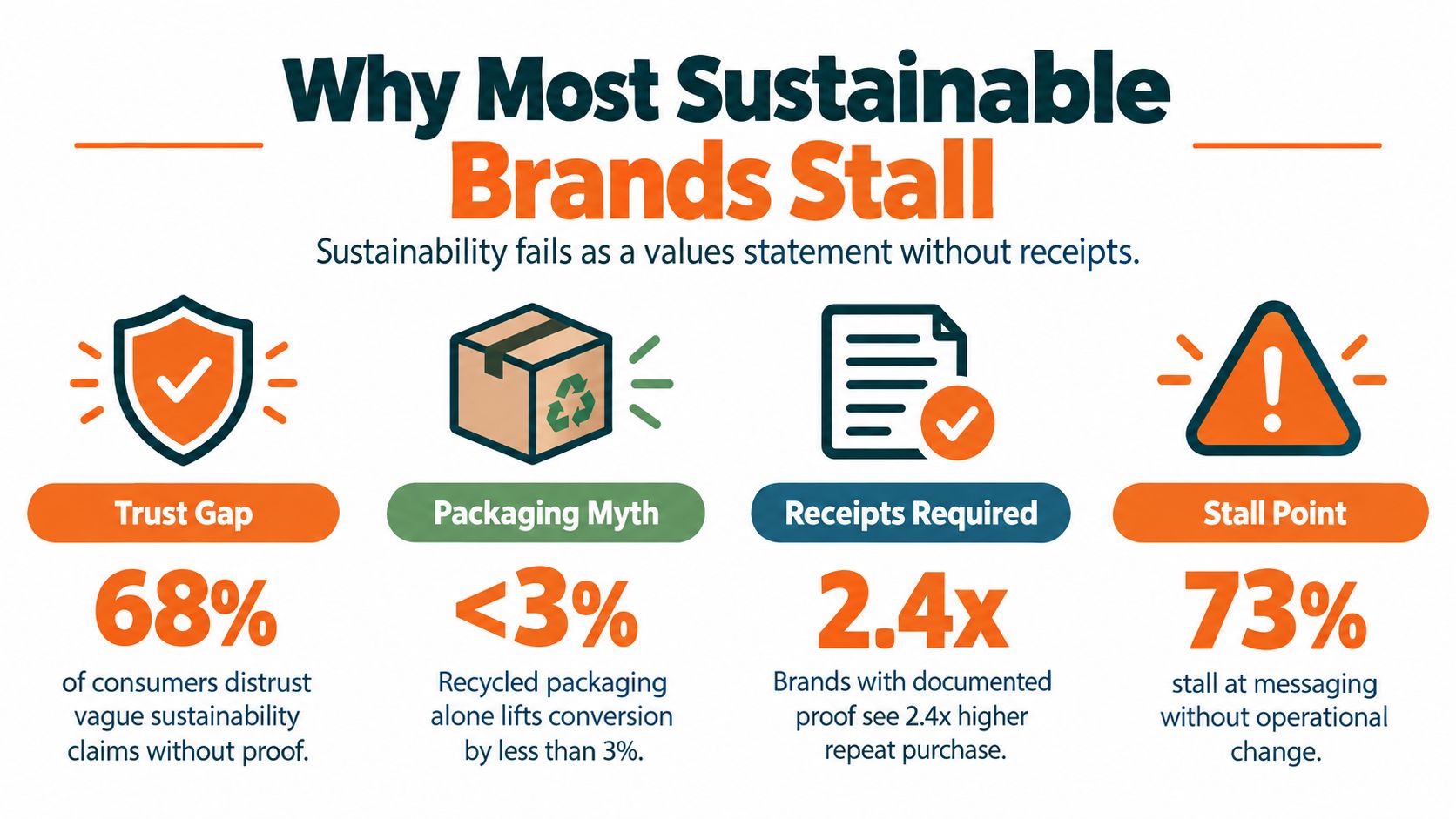
Sustainable brands do not stall because customers hate sustainability. They stall because founders treat it like messaging before they treat it like proof.
I've seen this play out over and over. A founder spends weeks polishing mission language, adds recycled packaging, posts a supplier photo, and assumes trust will follow. It won't. Trust comes from an evidence stack buyers can check for themselves. Quantified claims. Third-party certifications where they matter. Plain disclosure about what is true, what is in progress, and what is still messy.
Three ways founders kill the brand early
The first mistake is selling ethics before selling usefulness. If the product needs a long speech to justify the purchase, demand is weak. Good sustainable brands still win on function, convenience, design, status, price, or some mix of the five.
The second mistake is paying for better inputs without pricing power or margin discipline. Cleaner materials, tighter sourcing, testing, audits, and certification fees are real costs. If one upgrade wipes out your gross profit, you do not have a sustainability strategy. You have a subsidy.
The third mistake is publishing claims that cannot survive basic scrutiny. “Eco-friendly.” “Better for the planet.” “Responsibly made.” Those phrases sound safe, but they collapse the second a customer, retailer, or journalist asks for specifics.
Here's my rule. If a skeptical customer asks “prove it” and your team has to scramble in Slack, the claim is not ready for the homepage.
Skepticism is not the problem. Weak proof is.
The opportunity is still there, but only for brands that can convert doubt into confidence. In a Blue Yonder summary of consumer sustainability findings, nearly half of consumers across 23 countries reported buying at least one sustainable good or service, and those buyers estimated paying more on average. The same summary says 55% were skeptical of brand sustainability claims, and only 9% said they believed them.
That gap matters.
It means customers are open to paying for sustainability, but they do not trust marketing shortcuts. They trust evidence. A measured claim about recycled content. A certification with a standard behind it. A product page that shows what you know, what you cannot verify yet, and where the tradeoffs sit.
That is why I push founders to build the evidence stack early. Start with one claim that matters to purchase. Quantify it. Document it. Get outside validation if the category demands it. Then publish the proof in plain English. Sustainability stops being decoration the moment a buyer can verify it without taking your word for it.
Brands that get this right do not just look credible. They become easier to buy from.
Lock In Positioning and Product-Market Fit First
Founders love to lead with mission because it feels bigger than product. That instinct kills traction.
Buyers do not switch because your values are admirable. They switch because your offer fits their life better than the current option, and your proof removes the risk of trying it. Sustainability strengthens demand only after the product earns attention.
If you need a refresher on what is brand positioning, start there. Then force the brand into one paragraph that a skeptical customer could react to.
Write the positioning brief
Keep it blunt. If the language sounds broad, it is weak.
| Element | Weak Positioning | Strong Positioning |
|---|---|---|
| Buyer | “People who care about the planet” | “Urban parents replacing single-use lunch products with durable, low-mess options” |
| Problem | “Waste is bad” | “Disposable products are annoying to restock, look cheap, and create guilt after every use” |
| Alternative | “Other eco brands” | “Grocery-store basics, Amazon multipacks, and premium design-led brands” |
| Reason to choose | “Sustainable materials” | “Better function, cleaner design, and documented material standards” |
| Proof | “We care deeply” | “Material spec sheet, supplier documentation, and plain-language product page” |
The last row matters more than founders think.
Your proof cannot sit off to the side as a nice extra. It has to support the buying decision. If your buyer cares most about durability, show lifespan testing. If they care about ingredient safety, show the standard, test result, or certification. If they care about waste reduction, quantify the difference and explain the assumptions. That is the evidence stack at the positioning stage. A claim, a number, and a source people can check.
Pressure-test demand before you scale
I want evidence before inventory.
Run a pre-order. Put up a landing page. Buy targeted traffic. Offer two versions of the promise and see which one gets real clicks, real emails, and real checkouts. If you are still shaping the offer, use a practical product-market fit validation checklist for early-stage brands.
Then talk to ten likely buyers who have already bought in the category. I mean actual prospects with actual spending behavior.
Ask:
- What are you using now?
- What pushed you to buy it?
- What frustrates you enough to switch this month?
- Which proof would matter before you trust a new brand?
- What would make our sustainability claim sound inflated or vague?
Listen for purchase language. Ignore compliments.
I learned this the hard way. Early praise makes founders feel smart. Orders make them honest. If people say the idea is great but cannot tell you why they would switch, you do not have position yet. If they light up at one concrete improvement and ask whether you can prove it, you are getting close.
Build the offer around the switch, not the mission
A sustainable brand wins when it answers three questions fast.
Why this product. Why now. Why should I believe you.
Mission usually answers none of them. Product performance answers the first. Sharp positioning answers the second. The evidence stack answers the third. Put all three on the product page and weak demand gets exposed quickly, which is useful. It is far cheaper to fix a muddled offer now than after you have paid for packaging, inventory, and content built around the wrong promise.
Price to fund proof
Underpricing is one of the fastest ways to trap a sustainable brand in shallow claims.
Proof costs money. Testing costs money. Better sourcing, certification fees, traceability tools, clearer packaging, and support for skeptical buyers all cost money. If your margin cannot fund that work, your trust system falls apart the moment customers ask harder questions.
Price for credibility. Then earn it with evidence.
Unit Economics and Retention That Actually Hold
A sustainable brand that loses money on every early order isn't sustainable. It's a grant application with a logo.
I care less about what your model looks like at scale and more about whether each order works now. If you need huge volume before the economics make sense, your brand is already in trouble. Costs go wrong before they go right. Freight slips. packaging changes. suppliers miss dates. Returns show up in clusters.
The math I'd watch first
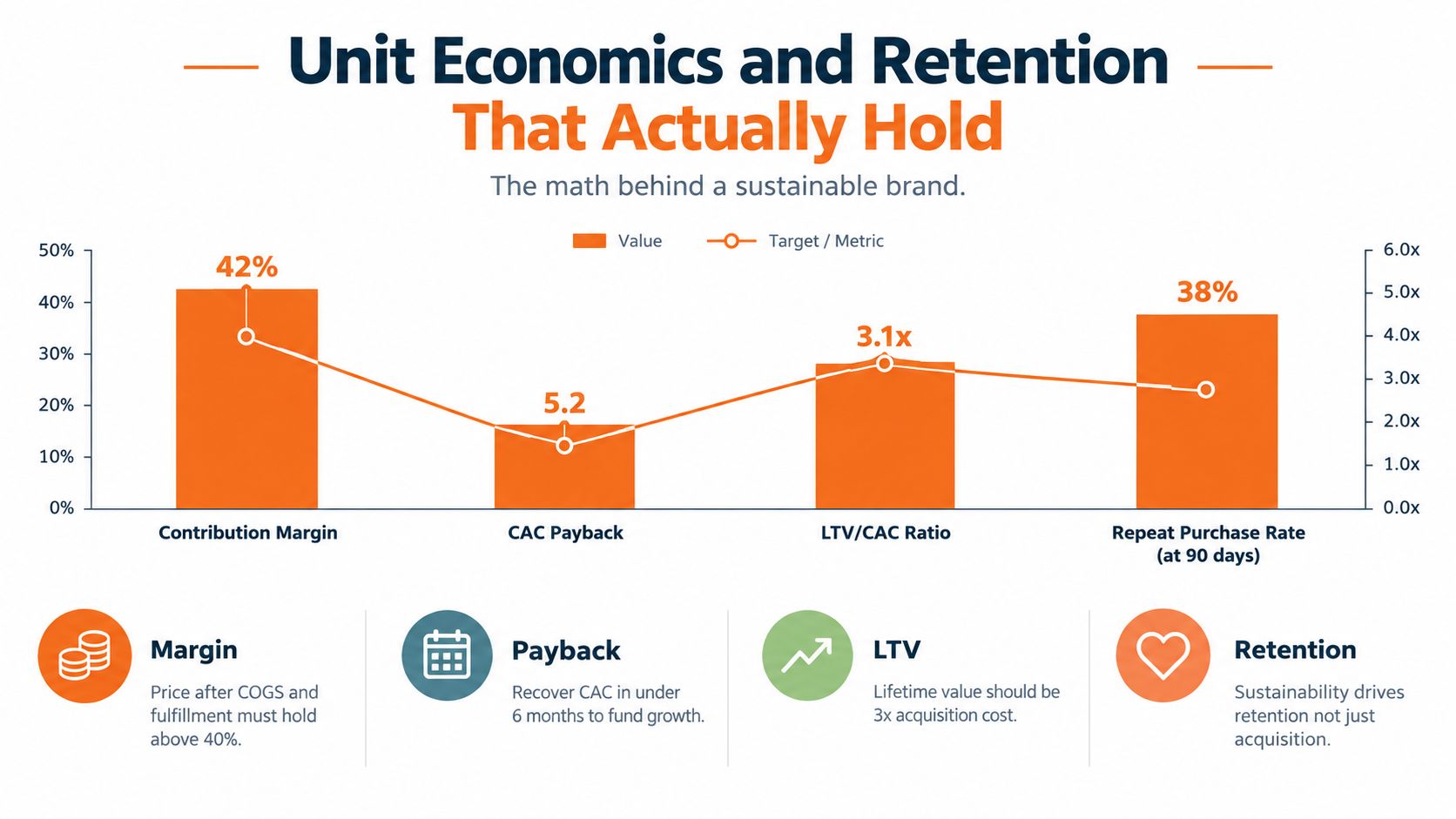
The infographic above gives you a working frame. Use it as a sanity check, not a law.
Here's the order I'd review every week:
- Contribution margin per order. Revenue minus product cost, packaging, fulfillment, payment fees, and channel-specific variable costs.
- CAC payback. How fast a new customer covers the acquisition cost.
- Repeat behavior. Whether people come back without needing a dramatic discount.
- Refunds and defects. These expose product truth faster than brand copy does.
If you want a founder-friendly view of durability over hype, this sustainable business growth guide is a useful frame.
Premiums work inside a trust band
Consumers will pay more for sustainable products, but founders get this wrong when they assume unlimited pricing power. PwC reported an average willingness to pay about 9.7% more for sustainably produced or sourced goods, with many studies clustering in a 5 to 10% band, and found that 80% of consumers were willing to pay up to 5% extra, 40% up to 10% extra, and only 7% beyond that in its consumer sustainability analysis.
That tells you something simple. You can't slap a huge markup on a mediocre product and call it ethics. The premium has limits. Your product still has to earn the purchase through function, design, convenience, or status.
Retention is the real proof
I care a lot about second purchase behavior because it cuts through storytelling. If someone buys once because they like your values, fine. If they come back, your product fits their life.
Build loops that make repeat purchase natural:
- Replenishment products need easy reorder timing.
- Durable goods need accessory, refill, or replacement pathways.
- Community-led brands need reasons for buyers to stay in orbit after checkout.
A repeated order is a cleaner signal than applause on launch day.
Supply Chain, Impact, and the True Cost of Proof
Sustainability does not live in your copy. It lives in your records.
Founders burn cash on pretty stories before they build a proof system. I have seen brands spend months refining eco language while their supplier files were a mess, their packaging claims were loose, and nobody could produce a clean audit trail. That is backwards. Buyers trust what you can document.
Choose suppliers by verifiability
Local versus global is an operations decision, not a moral identity.
Use a simple scorecard: landed cost, lead time, minimum order flexibility, defect rate, documentation quality, and how fast a supplier can answer a claim question with evidence. If a factory makes big promises and sends vague PDFs, I do not care how good the pitch sounds. You are buying future risk.
The point is simple. Every sustainability claim creates a burden of proof. If you cannot trace that claim through purchasing, production, and packaging, do not publish it.
For a café brand or food-adjacent business, packaging decisions usually shape trust faster than broad mission language. A practical read on compostable cups for cafés is useful because it gets into material trade-offs instead of recycling slogans.
Build an evidence stack customers can check
I treat sustainability as a trust system with three layers. First, a quantified claim. Second, outside verification where it matters. Third, clear disclosure that lets a skeptical buyer follow the logic without emailing support.
Add a fourth layer behind the scenes. Keep your internal records clean before anyone asks for them.
Here is the framework I use:
Quantified claim
Make the claim narrow enough to verify. “Made with FSC-certified paper” is workable. “Better for the planet” is fluff.Third-party certification
Use certifications that match the purchase driver in your category. Company-level badges do one job. Product-level standards do another.Transparent disclosure
Show scope, limits, and trade-offs. If only the carton is certified, say the carton is certified.Internal recordkeeping
Store invoices, spec sheets, audit notes, chain-of-custody documents, and supplier attestations in one place.
That stack converts skeptics because it answers the questions serious customers already have. What exactly are you claiming? Who checked it? What does it cover? What does it not cover?
Use certifications with restraint
Certifications cost money, time, and staff attention. Treat them like assets, not ornaments.
| Certification | Typical Annual Cost | Audit Effort | Proof Value to Buyers |
|---|---|---|---|
| B Corp | Varies by company size and scope | Moderate to high | Strong for company-level values, weaker for a single product claim |
| Fair Trade | Varies by product and supply chain | Moderate | Strong when labor conditions are central to the purchase |
| GOTS | Varies by textile scope | High | Strong for textile and material integrity claims |
| FSC | Varies by product and chain of custody | Moderate | Strong for paper and wood-based packaging claims |
| Climate Neutral | Varies by emissions footprint and verification scope | Moderate to high | Useful when backed by clear explanation, weaker when used as a slogan |
I am keeping the cost guidance qualitative because fees change with product scope, supply chain complexity, and certifier requirements.
If you are deciding where operational proof should support your social claims, this social impact strategy guide for growing brands is a useful planning reference.
Publish claims in the right order
Do not market ahead of your documentation.
EU Green Transition consumer protection rules are scheduled to restrict vague environmental claims, and recognized verification schemes are expected to matter more from September 27, 2026, according to the Carbon Trust overview of rising scrutiny on green claims. That pressure is not just a compliance issue. It is a conversion issue. The brands that win will not be the ones saying more. They will be the ones proving more.
Brand Voice and Community That Earns Trust
Your brand voice should sound like one accountable adult, not a committee trying to avoid criticism.
That matters more now because buyers have become harder to impress and quicker to doubt. A lot of “eco” content reads like a student presentation. Big claims. Soft language. No receipts. People tune it out.

Three voice rules I'd enforce
First, name the trade-off. If a material improved one thing but raised cost or lead time, say that. Adults trust adults.
Second, ban vague moral language. Words like “planet-friendly,” “conscious,” and “better for the future” usually signal weak proof. Replace them with plain claims tied to product pages, supplier standards, or audit notes.
Third, write like support and marketing sit at the same desk. If customer service wouldn't know how to defend the sentence, cut the sentence.
Try a simple excerpt test. Pull any three lines from your homepage, an Instagram caption, and a product page. If they don't sound like the same person, your voice is fake.
Community is behavior, not audience size
An audience watches. A community replies, asks, complains, shares, and returns.
The easiest rituals are usually the best:
- Monthly founder AMAs where you answer hard questions about sourcing, price, and quality.
- Behind-the-scenes proof posts that link to material specs, certifications, or process notes.
- Founder-led complaint handling for sensitive issues, especially when the complaint touches quality or trust.
Consumers are actively questioning sustainability claims. Recent consumer trend coverage says 62% believe companies are greenwashing, concern about greenwashing rose from 8% in 2022 to 43% in 2025, and trust in sustainability messaging fell from 79% to 65% over that period in the Sustainable Jungle consumer trends summary. That's why founder voice matters. Clean copy from a brand account isn't enough anymore.
Here's a useful conversation on how trust compounds when the communication is human and specific:
What earns the right to sell
I'd post fewer slogans and more proof artifacts. Show the packaging revision. Show the supplier questionnaire. Show the failed sample and why you rejected it. Show the trade-offs in cost.
A buyer doesn't need you to be flawless. A buyer needs to know you're telling the truth.
That tone also matches what trust research is showing in younger buyers. A Frontiers study on Gen Z and sustainable packaging says environmental awareness and green values influence willingness to pay mainly through brand trust, while eco-label credibility and communication transparency strengthen that link.
The Only Metrics Worth Watching Weekly
Most founder dashboards are stuffed with trivia. Follower count. Reach spikes. Open rate screenshots. None of that tells me whether your brand is getting sturdier.
I want a weekly scorecard that answers one question. If demand gets choppy next month, does the brand still stand up?
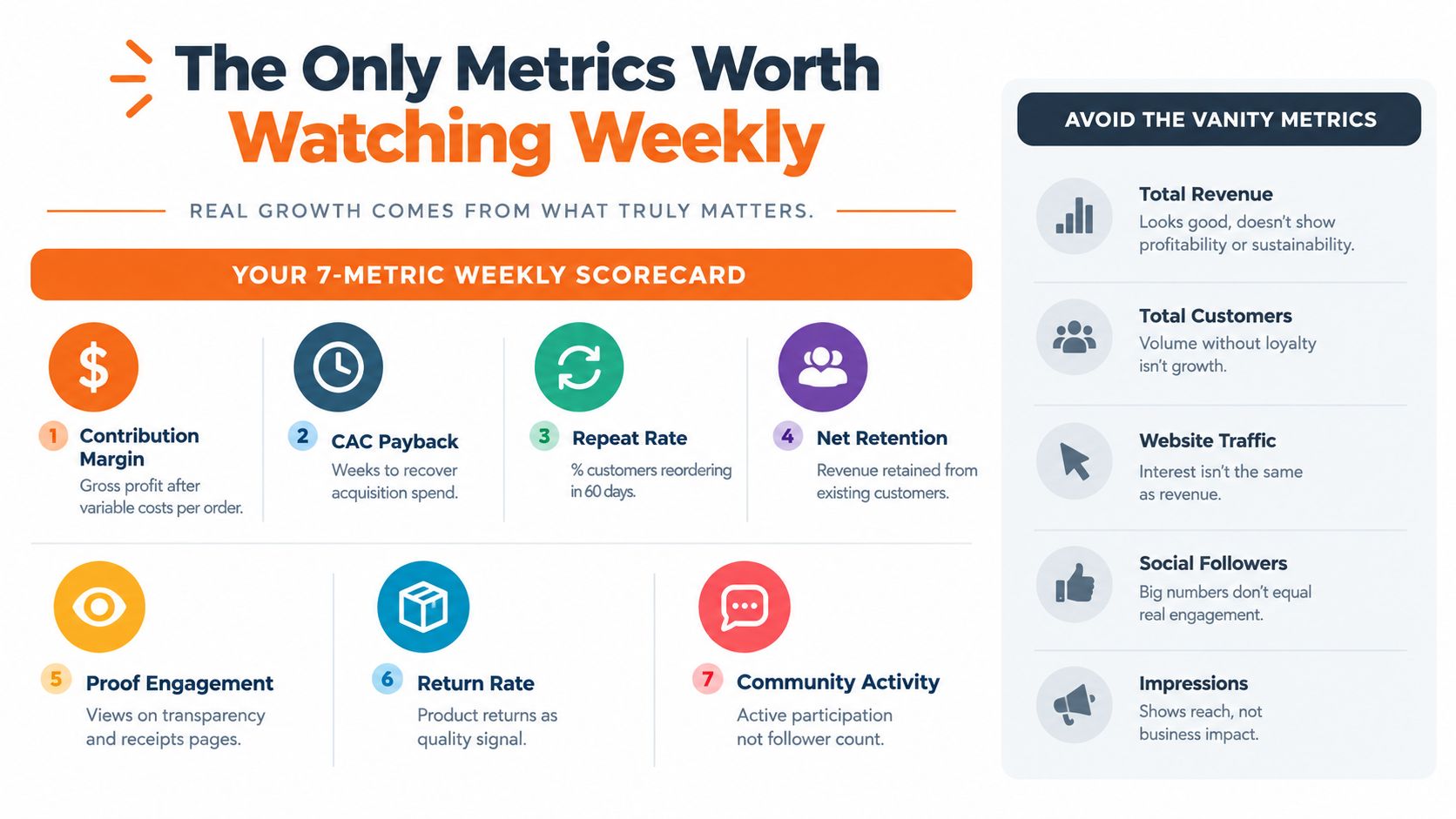
The seven metrics that matter
I'd track these every week in one sheet:
- Contribution margin per order because this tells you whether each sale helps or hurts.
- CAC payback because cash timing kills more brands than bad ideas.
- Repeat purchase rate because return behavior beats launch-day excitement.
- Net revenue retention because existing customers should carry more of the business over time.
- Proof engagement because visits to transparency, sourcing, and receipts pages show whether buyers use your evidence stack.
- Return and defect rate because quality problems destroy trust faster than weak ads do.
- Community activity because active questions, replies, and user participation mean more than passive followers.
Ignore the vanity pile
I'd ignore follower count almost completely. I'd also ignore email open rate as a standalone metric and one-time conversion rate without context. Those numbers can move while the business gets worse.
What matters is whether the system is tightening:
- Are customers coming back?
- Are claims getting used in the buying process?
- Are defects low enough to protect trust?
- Does each order create enough profit to fund better proof?
Weekly check: If your proof pages get traffic but your conversion stalls, your claim may be interesting but not purchase-relevant.
There's another reason to localize this dashboard. Willingness to pay for sustainability changes by market. Bain reports a 12% average willingness to pay more for products with minimized environmental impact, and says 50% list sustainability among their top four purchase criteria, with accepted premiums of 20% in India, 16% in Brazil, 15% in China, 11% in the U.S., 9% in Germany, and 8% in the UK in the Bain survey summary at ESG Today. Don't evaluate every region with the same assumptions.
Your First Thirty Days Building a Sustainable Brand
You don't need a giant strategy deck. You need thirty days of honest work and a stack of documents that tell the truth.
I'd run the month like an operator, not a copywriter.
Days 1 through 7
Pressure-test the position. Talk to ten likely buyers. Rewrite the homepage promise after every few calls if you need to.
Then document your current evidence stack. What claims are already on your site, packaging, sales deck, or social posts? Which ones have proof attached? Which ones would fall apart under scrutiny?
If you need a clean outside perspective on ecommerce foundations, this piece on ECORN ecommerce brand strategy is worth a skim.
Days 8 through 14
Rebuild the unit economics from scratch. Don't use optimistic assumptions. Use current costs, likely return behavior, and the fulfillment setup.
Create a single spreadsheet with:
- Order-level margin
- Acquisition cost by channel
- Expected repeat window
- Refund and defect notes
- Proof-related costs like testing, certification, better packaging copy, or traceability work
A lot of founders realize their “ethical premium” is really a margin leak.
Days 15 through 21
Map the supply chain. List every supplier, every claimed standard, every document you hold, and every gap.
Then make the local-versus-global call with hard criteria. I'd score each option on verification ease, lead time predictability, minimum order flexibility, and claim strength. If a sourcing choice makes a beautiful story but weakens cash flow and still doesn't improve proof, kill it.
Days 22 through 30
Publish one proof artifact. One. A material standard explainer. A sourcing page. A packaging breakdown. A certification note with plain-language context.
Then install the weekly scorecard and recruit five founder-mode advocates. I mean people who will tell you when the product, price, claim, or communication feels off. If you can get that kind of feedback in a private operator circle, use it. Chicago Brandstarters has small private founder dinners and group chat support for early-stage builders, which is useful when you need blunt feedback on positioning, demand, and survivability rather than networking theater.
Here's the one-page checklist I'd use:
- Positioning brief with one buyer, one problem, one proof-backed promise
- Ten interview notes with switching triggers and trust blockers
- Unit economics sheet with margin and payback visibility
- Supply chain map with documents attached
- Claim audit showing what stays, what gets cut, and what needs proof
- First proof artifact published publicly
- Weekly scorecard live and reviewed on the same day each week
That's enough to tell you whether you're building a sustainable brand or just describing one.
If you're building a sustainable brand and want blunt feedback from founders who are in the trenches, Chicago Brandstarters can help. It's a free vetted community for early-stage and growing founders who want honest conversations about positioning, product-market fit, retention, and durable growth. Visit Chicago Brandstarters and see if it fits how you want to build.
Leave a Reply