
You probably know this feeling.
You get the idea on a walk through Wicker Park, on the Metra, or while half-listening in a Zoom meeting you should've declined. For ten minutes, you're flying. Then the panic hits. What if I tell the wrong contractor? What if somebody grabs the name first? What if I build this thing and a bigger company copies it?
I've been around enough founders to tell you this is normal. It's also where a lot of people waste time and money. They either freeze, or they run straight to expensive legal work before they've even sold anything.
I wouldn't do either.
If you want the straight answer on how to protect intellectual property, treat it like protecting a house you're still building. First, lock the doors. Then label what you own. Then register what matters most. Then prepare for the day some idiot tries to take it.
That "Million Dollar Idea" Panic Is Real
A founder tells a friend about a product idea over coffee in Fulton Market. A week later, he's checking domain names at 1 a.m., searching trademarks, and wondering if he just blew it by talking too soon.
I've seen that movie.
Most early founders think the idea itself is the asset. Usually, it isn't. The asset is the package around it. Your brand name. Your logo. Your product photos. Your code. Your customer list. Your process. Your formula. Your supplier setup. Your internal docs that show when you created the thing and who touched it.
That's the part people miss.
The first mistake
The first mistake is acting like IP protection starts with a lawyer. It starts with your habits. If your files are scattered across Gmail, random Figma drafts, text messages, and a contractor's laptop, you don't have protection. You have hope.
You can't defend what you can't prove you created, owned, or kept confidential.
For a Chicago or Midwest founder, this matters even more because most of us don't start with a giant legal budget. We start lean. We use freelancers. We move fast. We piece things together nights and weekends. That's fine. You can still protect yourself. You just need to do the boring stuff early.
The founder rule I actually follow
I use a simple rule. Protect the thing closest to revenue first.
If you're building a consumer brand, that's often the name and logo. If you're building software, that's often code ownership, access control, and contractor agreements. If your edge is a process or formula, that's trade secret discipline.
That mindset will save you from two dumb extremes:
- Over-lawyering too early
- Ignoring IP until someone copies you
Both are expensive. One just sends the bill sooner.
What Exactly Is Your "Intellectual Property"?
Most founders say, "I want to protect my idea." That's too vague to be useful. Break it down.
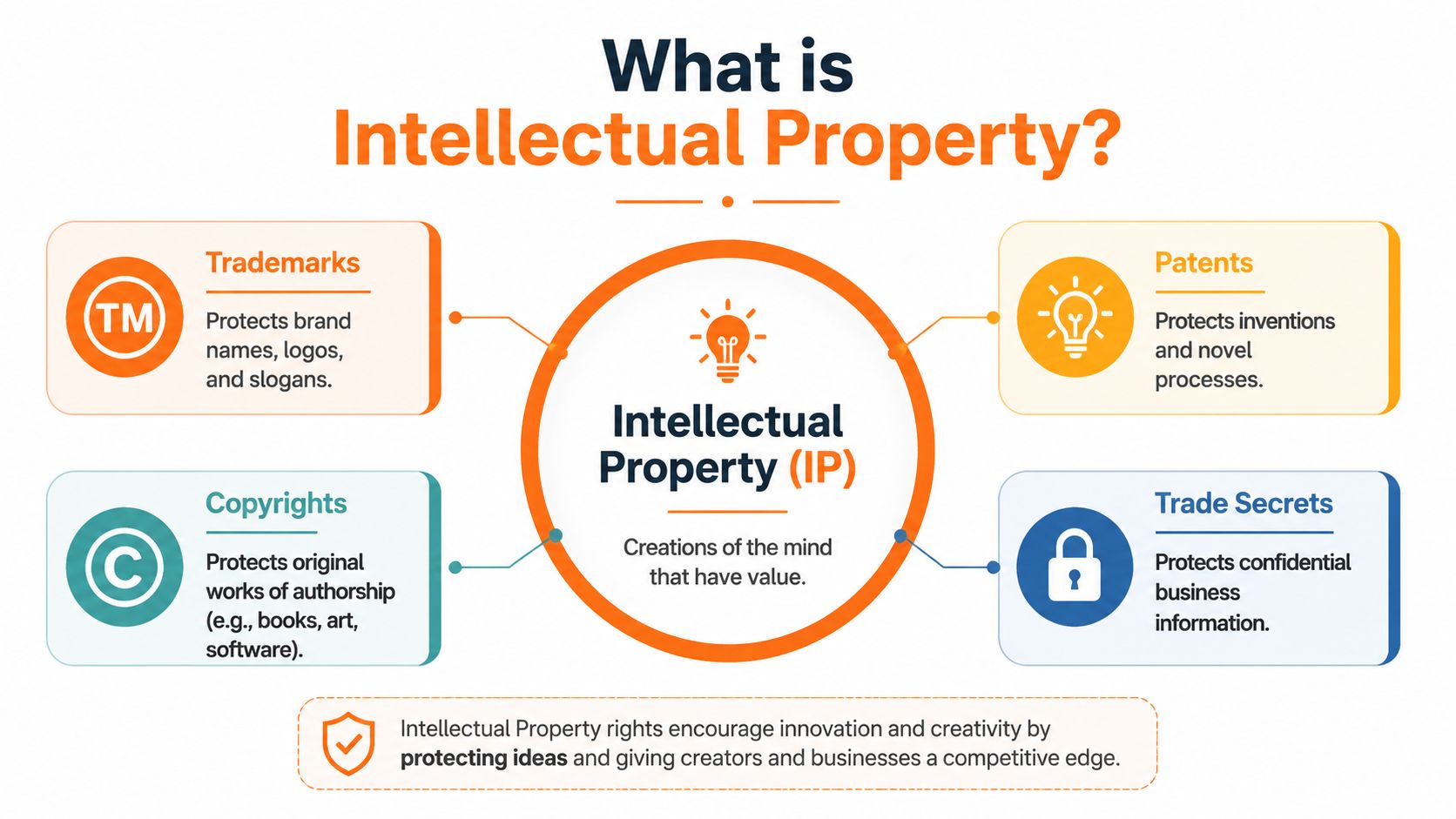
Your IP usually fits into four buckets. Think of them as four locks for four different doors.
Trademark is your name tag
A trademark protects the parts of your brand people recognize. Your business name. Logo. Slogan. Sometimes product line names too.
If you're selling coffee, skincare, apparel, or a SaaS tool, the trademark is the name tag on your shirt. It tells the market, "This came from me." If somebody shows up wearing a fake version of your name tag, that's where trademark law comes in.
For most brand builders, this is the first place I look. In the European Union, trademark registration is the most common IP protection method, used by one-third of enterprises that use four protection strategies, while patent applications and registered industrial designs are each used by 28%. For brand builders, trademark registration is a strong first move for brand identity, according to Eurostat's data on IP protection methods.
Copyright is your blueprint
A copyright protects original creative work. Website copy. Product photos. Packaging art. Videos. Music. Software code. Blog posts.
If trademark is the name tag, copyright is the blueprint in the drawer. It covers the expression of the work, not the general concept. You can't copyright "a meal prep app." You can protect the code, designs, written copy, and artwork you made for it.
Patent is your machine design
A patent is for inventions and novel processes. New hardware. A chemical formula. A manufacturing process. A technical method.
This one is where founders get dreamy and broke at the same time. Patents can matter a lot, but they aren't the default answer for every startup. If your business lives or dies on a real technical invention, look hard at patents. If you're just trying to protect a brand, don't start here.
Trade secret is your family recipe
A trade secret is confidential business information that gives you an edge. Think Coca-Cola recipe energy. Your sourcing list, pricing logic, process docs, prompt library, formulas, or operating system can all fit here.
But trade secrets only exist if you treat them like secrets.
According to Traverse Legal's guide on protecting intellectual property, if you fail to use reasonable measures to keep information confidential, your litigation success rate is 0%. With documented protocols like separate NDAs, encrypted data, access logs, and employee training, defense viability rises to over 85% in major markets.
Make your IP map
Do this in a Google Sheet today.
| Asset | Type | Owner | Status |
|---|---|---|---|
| Brand name | Trademark | Company or founder | Unfiled or pending |
| Product photos | Copyright | Company | Created |
| App code | Copyright / trade secret | Company | In development |
| Formula or process | Trade secret / patent | Company | Confidential |
| Packaging design | Copyright / trademark | Company | Drafted |
If admin work makes you want to gouge your eyes out, you can find IP paralegals via HireParalegals to help clean up filings and paperwork without going straight to high-end law firm rates.
Your Day-One IP Playbook
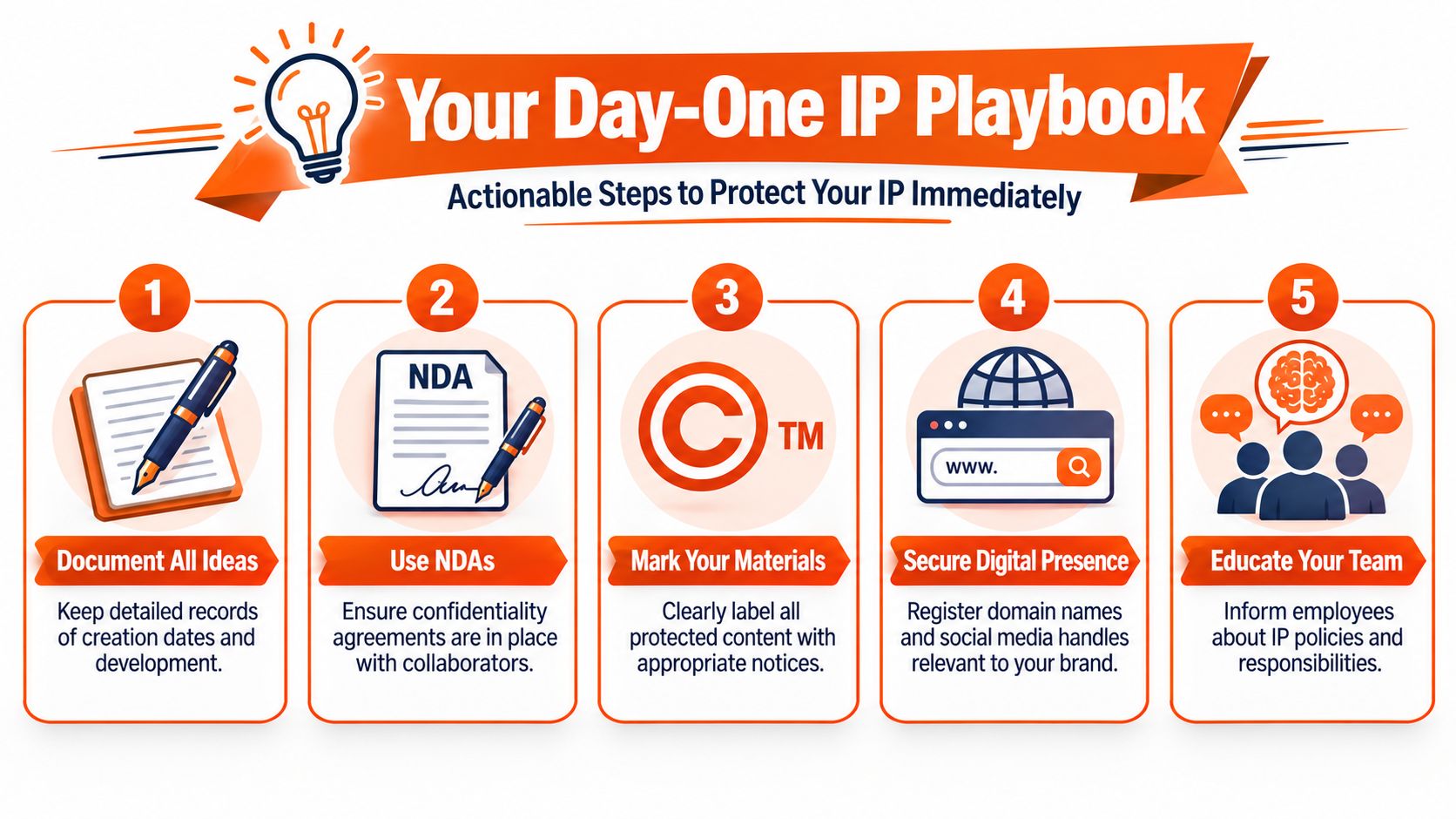
You don't need a fancy legal stack on day one. You need clean habits. Think deadbolt, not moat.
Start with proof
The first thing I want from any founder is a paper trail. Use Google Docs version history, Figma timestamps, GitHub commits, dated notes, Loom walkthroughs, and organized folders in Drive, Dropbox, or Notion.
Per the U.S. Chamber's guide to intellectual property enforcement, your evidence folder should include screenshots, URLs, packaging photos, dated drafts, version histories, and metadata. It also notes that failure to file within 12 months of first public disclosure or sale can permanently forfeit rights in many situations, so document first use, first sale, and first disclosure immediately.
Practical rule: If you made it, save the dated draft. If you shared it, log who saw it and when.
Use separate NDAs, not mushy contract language
If you share sensitive IP with employees, contractors, or third parties, use a real NDA. It needs to define what is confidential and spell out the consequences of disclosure. That's how you reduce unauthorized disclosure and reverse engineering, as explained in Fortra's guidance on safeguarding your ideas.
And don't hide ownership language inside a generic offer letter and call it a day. Traverse Legal is blunt on this point. Separate, standalone agreements with explicit IP assignment language are much safer than bundled clauses that courts may view as ambiguous.
Lock down access
Trade secret protection dies when everybody has the password.
Give people access by role. Your freelance designer doesn't need your supplier pricing sheet. Your junior VA doesn't need source files for every product launch. Use tools you already have. Google Workspace permissions. GitHub repo access. 1Password. Device encryption. Shared-drive rules.
If you're weak on the technical side, read a guide to network security from tekRESCUE and apply the basics. A lot of IP theft doesn't look like a movie scene. It looks like sloppy file sharing.
The video below gives a decent overview of early protection moves.
Teach your team what matters
A founder assumes, "My team knows not to leak stuff." Usually they don't. They know what you repeated, trained, and documented.
Here's the short version of what every hire and contractor should hear:
What is confidential
Product plans, source files, customer data, pricing, formulas, unreleased designs, and strategy docs all count.Where it can live
Company-approved tools only. Not personal email. Not random USB drives. Not "I'll just text it to myself."What happens when they leave
Access ends. Devices get reviewed if needed. Files stay with the company.
Mark and organize what you create
You don't need to tattoo legal symbols on everything, but you should label assets clearly. Put ownership in file names and folder structure. Use consistent contract templates. Save signed agreements in one place.
When founders ask me how to protect intellectual property cheaply, this is my answer: create order before you create paperwork.
Making It Official A Founder's Guide to Registration
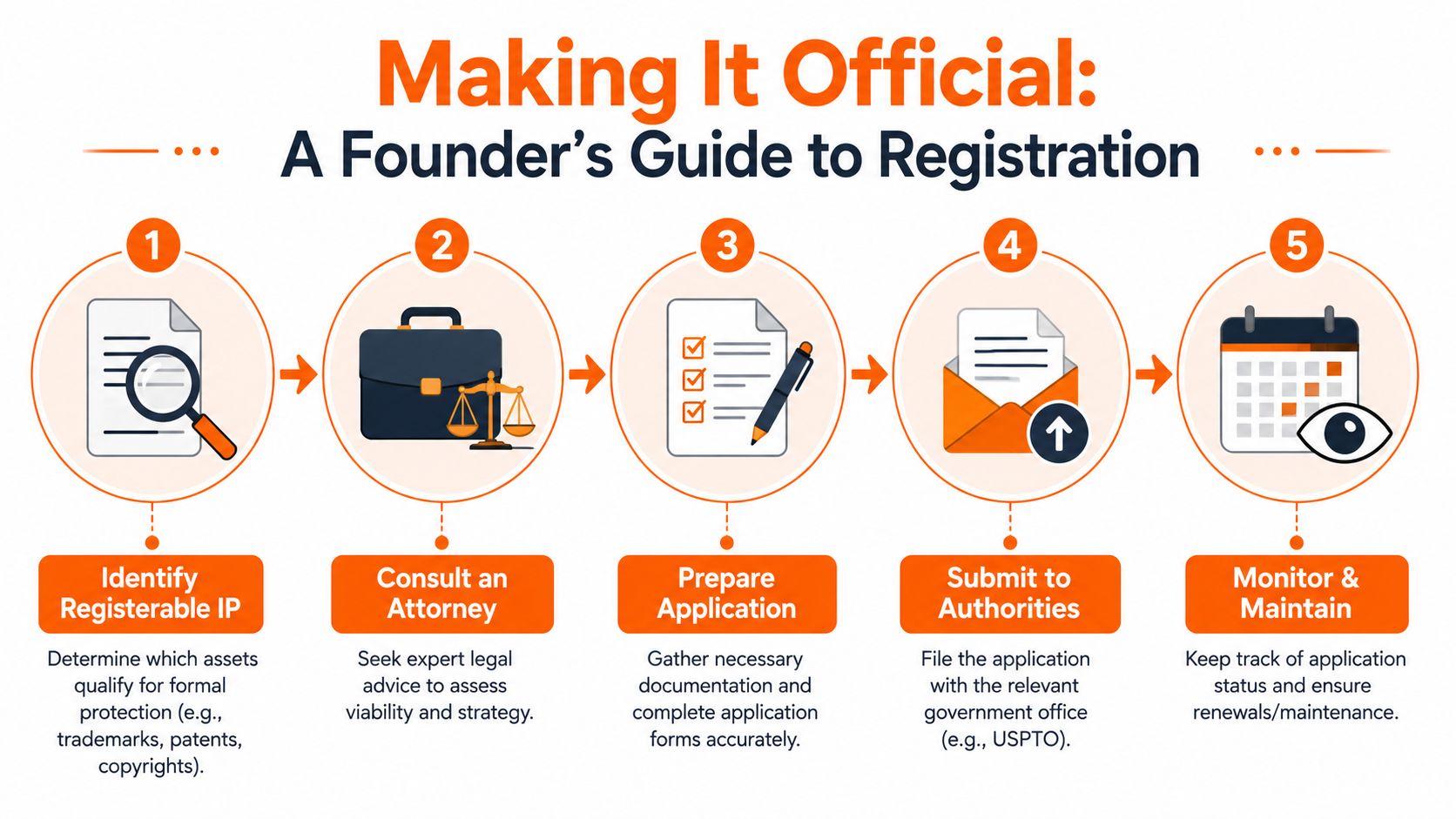
Registration is where you plant your flag. If day-one hygiene is locking your doors, registration is putting your name on the deed.
If you're a brand builder, start with trademark
I have a strong opinion here. If you're building an ecommerce brand, packaged good, agency, or consumer app, your first formal registration move is usually the trademark.
Why? Because customers buy and remember the brand before they understand the backend. The name, logo, and symbols are what people see first. If someone grabs a confusingly similar mark, they can siphon trust you paid to create.
The Eurostat data above gives you the directional clue. Trademarks are the most common protection method among companies using multiple IP strategies. That's not random. It's practical.
A few founder rules I like:
- File the name before the logo if cash is tight. A good word mark usually has more long-term flexibility.
- Check conflict risk early before you print packaging, buy signs, or commit to inventory.
- Match filing to your market. If you plan to sell in the U.S., file there. If you're expanding abroad, think ahead.
If you need a simple plain-English primer before you choose, compare patent and trademark options from Lerner & Weiss APC.
Copyright is easier than founders think
For content-heavy businesses, copyright matters more than many people realize. Product photography, ad creative, site copy, email flows, software code, and original illustrations all live here.
You already own many copyrights once the work is created, but registration gives you stronger enforcement options. That's why I tell media brands, software founders, and ecommerce operators with lots of original content to take this more seriously than they usually do.
If your business creates content every week, your copyright stack is probably larger than your trademark stack.
Patents are real, but don't cosplay as a patent company
A lot of founders burn months acting like they're building a deep-tech moat when they're really building a normal business with good branding and execution.
Patents can be the right move for a novel invention or process. If that's you, register with the USPTO in your target markets. Bernstein's IP protection guide also notes that blockchain timestamps can support priority claims and help prove prior art in disputes.
But if you're selling candles, supplements, apparel, or a services-backed SaaS, don't use patents as procrastination.
My registration priority list
| If your business is mostly… | Register first |
|---|---|
| Ecommerce or consumer brand | Trademark |
| Media, education, design, software content | Copyright |
| Novel device, process, or formula | Patent review |
| Secret process, list, or workflow | Internal controls and NDAs |
Registration is strategy, not bureaucracy. Spend where the business lives.
What to Do When Someone Rips You Off
You find your product photos on another site. Or a knockoff listing pops up on Amazon. Or some lazy competitor lifts your homepage copy line for line.
Don't send the angry text. Don't post on LinkedIn. Don't start with emotion.

Build the evidence folder first
Before you contact anyone, capture everything.
Take screenshots. Save URLs. Download product pages. Photograph packaging. Export your original drafts, metadata, invoices, and timestamps. Put it all in one secure folder. Keep a short timeline doc with dates and links.
This sounds boring because it is. It's also what keeps a dispute from turning into a he-said-she-said mess.
Then send a real cease-and-desist
According to the U.S. Chamber guide cited earlier, 70 to 80% of disputes are resolved without court action, and cease-and-desist letters drafted with attorney involvement have over 90% success in trademark and copyright cases, while self-drafted letters land closer to 45 to 55%.
That doesn't mean you hire counsel for every minor issue. It means you should know when your DIY letter is likely to get ignored.
A good letter has:
- A clear statement of what they used
- Proof that you own the original work
- A specific ask, like remove the listing, stop using the photos, or transfer a confusing domain
- A deadline
- A tone that is firm, not hysterical
Don't threaten a legal apocalypse in writing unless you're ready to follow through.
Use the right escalation ladder
I think about enforcement in four levels:
- Document
- Direct contact or formal letter
- Platform complaint or takedown process
- Lawyer-led escalation
If you're dealing with serial nuisance litigants, it helps to understand what patent trolls are and how they operate. You don't want to confuse a random copycat seller with a party that makes money by weaponizing IP process.
Move fast, stay calm
Delay is expensive. Founders wait because they hope the issue disappears. It usually doesn't. Handle it while the trail is fresh and before the copy spreads across marketplaces, social channels, and search results.
How to Afford IP Protection Without Going Broke
The wrong way to think about IP is, "Can I afford this right now?"
The better question is, "What's the cheapest move that lowers the biggest future risk?"
I don't say that to sound philosophical. I say it because cleanup is brutal. According to G2's roundup of intellectual property statistics, defending a patent lawsuit in the United States can cost up to $3 million, and 76% of intellectual property cases end in voluntary settlements. That's exactly why preventive work is the better buy.
Spend in layers
If you have no revenue, spend time before money.
Use clean naming files. Lock down access. Get signatures. Keep dated records. Use standalone NDAs and assignment agreements. Register the domain names and social handles you need. Make sure contractor work belongs to the company.
If you have a little revenue, buy the most impactful legal move first. For many founders, that's trademark work. For content-heavy businesses, it may be copyright registration. For invention-led companies, it may be a patent consult before you disclose too much.
If you have steady revenue, clean the whole house. Audit agreements. Review ownership. Fix contractor paperwork. Build monitoring and enforcement processes.
Cheap now beats expensive later
Here's the simple comparison.
| Stage | Smart spend | Dumb spend |
|---|---|---|
| No revenue | Docs, NDAs, access control, naming checks | Full legal stack for assets that don't matter yet |
| Early revenue | First registrations tied to revenue | Waiting until a conflict appears |
| Growing | Portfolio cleanup, monitoring, counsel on edge cases | Fighting preventable disputes |
A lot of founders also create cash problems by treating every legal bill as an emergency. It helps to build a plan the same way you'd handle inventory or payroll. If your finances are messy, get your basics straight with cash flow management for small business. IP gets much easier when you stop making every decision under cash panic.
Where I'd be cheap and where I wouldn't
I'd be cheap on admin. I'd use templates carefully. I'd organize evidence myself. I'd learn filing basics.
I would not be cheap on a trademark conflict, a patent strategy call, a messy cofounder ownership issue, or a serious infringement letter that needs teeth.
That's the difference. Save money on process. Spend money on judgment.
DIY vs Lawyers and Finding Chicago Help
You can do more yourself than most law firms want you to believe. You can also wreck your position by winging the wrong parts.
The trick is knowing the line.
DIY is fine for this stuff
I think most early founders can handle these without much drama:
Creating the IP map
List assets, owners, status, and where the files live.Cleaning up records
Version history, dated drafts, evidence folders, and disclosure logs are founder work.Basic confidentiality habits
Access controls, company folders, password managers, and offboarding checklists.Simple operational education
Tell your team what is confidential and where it belongs.
Call a lawyer for this stuff
The second bucket is where mistakes get expensive.
| Situation | My advice |
|---|---|
| Trademark conflict or refusal risk | Get lawyer review |
| Patentable invention or public disclosure risk | Get lawyer review fast |
| Contractor or employee ownership mess | Get lawyer review |
| Serious infringement by a real competitor | Use lawyer-backed letter |
| Fundraising or acquisition diligence | Clean up with counsel before you get exposed |
For trade secrets, founders get sloppy because the assets feel invisible. That's exactly why they get burned. Fortra's write-up on IP loss and compromise notes that 78% of startups skip employee IP training, and courts have dismissed trade secret claims when companies lacked basic documented security measures.
Privacy isn't protection. Documentation is protection.
Chicago help that actually makes sense
If you're in Chicago or the Midwest, don't assume your only options are giant firms with giant invoices.
Start with practical places:
- University law clinics if you need guided help and can move a bit slower.
- Solo and small-firm IP attorneys who work with startups and don't talk like they bill by the syllable.
- Paralegal support for filing prep and admin cleanup.
- Founder communities and incubators that can point you to people who've already solved your exact problem.
If you're still building your support network, this roundup of incubator options near you is a useful starting point. The warm intro to a good operator-friendly lawyer is often worth more than hours of random Googling.
My blunt rule
Do the setup yourself. Pay for review where the downside is ugly.
That's how I think about how to protect intellectual property without turning your startup into a legal hobby.
If you want honest founder-to-founder feedback on messy decisions like IP, vendor risk, cash crunches, hiring, or whether you're overthinking your first move, check out Chicago Brandstarters. It's a free community for kind, bold, hard-working Chicago and Midwest founders who want real conversations, small private dinners, and practical advice without the fake networking energy.
Leave a Reply