
You're probably in one of two spots right now.
Either you just made your first real money and you're feeling good, until you remember the IRS and Illinois are about to put their hands out. Or you're still early, maybe pre-product, maybe first customers, and you want to avoid the classic founder mistake of treating taxes like a problem for “later.”
I've seen that movie. It ends with a founder staring at a tax bill like it's a ransom note.
Good business tax planning isn't nerdy paperwork. It's cash preservation. It's how you keep more fuel in the tank for inventory, ads, payroll, and another few months of runway when the Midwest winter gets long and sales get weird. If you're a Chicago founder in your first three years, you do not need enterprise tax theory. You need the handful of moves that change your outcome.
Your First Big Tax Bill Does Not Have to Be a Nightmare
A founder closes a strong year. Money is finally landing in the bank. They buy software, hire a contractor, maybe sign a small warehouse lease, maybe even take a breath and think, “Alright, this thing is working.”
Then tax season arrives. Their bookkeeper asks a few questions they should've answered months ago. Nobody set money aside. Nobody made estimated payments. They paid themselves in whatever way felt easiest. The tax bill shows up and wipes out the cash they thought they had for growth.
That pain is avoidable.
I don't think about taxes as a once-a-year filing event. I think about them like a slow leak in a tire. If you catch it early, it's annoying. If you ignore it, you're stranded on Lake Shore Drive in the snow.
The first fix is simple
You need a system before you need a miracle. That means:
- Separate your business money fast: One business bank account. One business card. Clean books from day one.
- Decide how you'll pay yourself: If you're winging owner draws or payroll, read this guide on how to pay yourself from your business before you create a mess you'll need to unwind later.
- Know what your entity has to file: If you're running a C corporation, this plain-English C Corp tax filing guide is a useful reality check on what Form 1120 involves.
Practical rule: If cash hits your account and you treat all of it like spendable money, you're already behind.
The founder mindset is usually “grow first, clean up later.” That works for landing customers. It's terrible for taxes. Tax agencies don't care that you were busy shipping product, chasing vendors, or fixing Meta ads.
What changes the outcome
The founders who stay calm in March usually did three things during the year:
- They tracked profit monthly.
- They planned for taxes before year-end.
- They picked a business structure that matched how the business made money.
That's the whole game in the early years. You do not need fancy strategies. You need clean books, a decent structure, and a habit of looking ahead.
Thinking About Taxes Like a Founder Not an Accountant
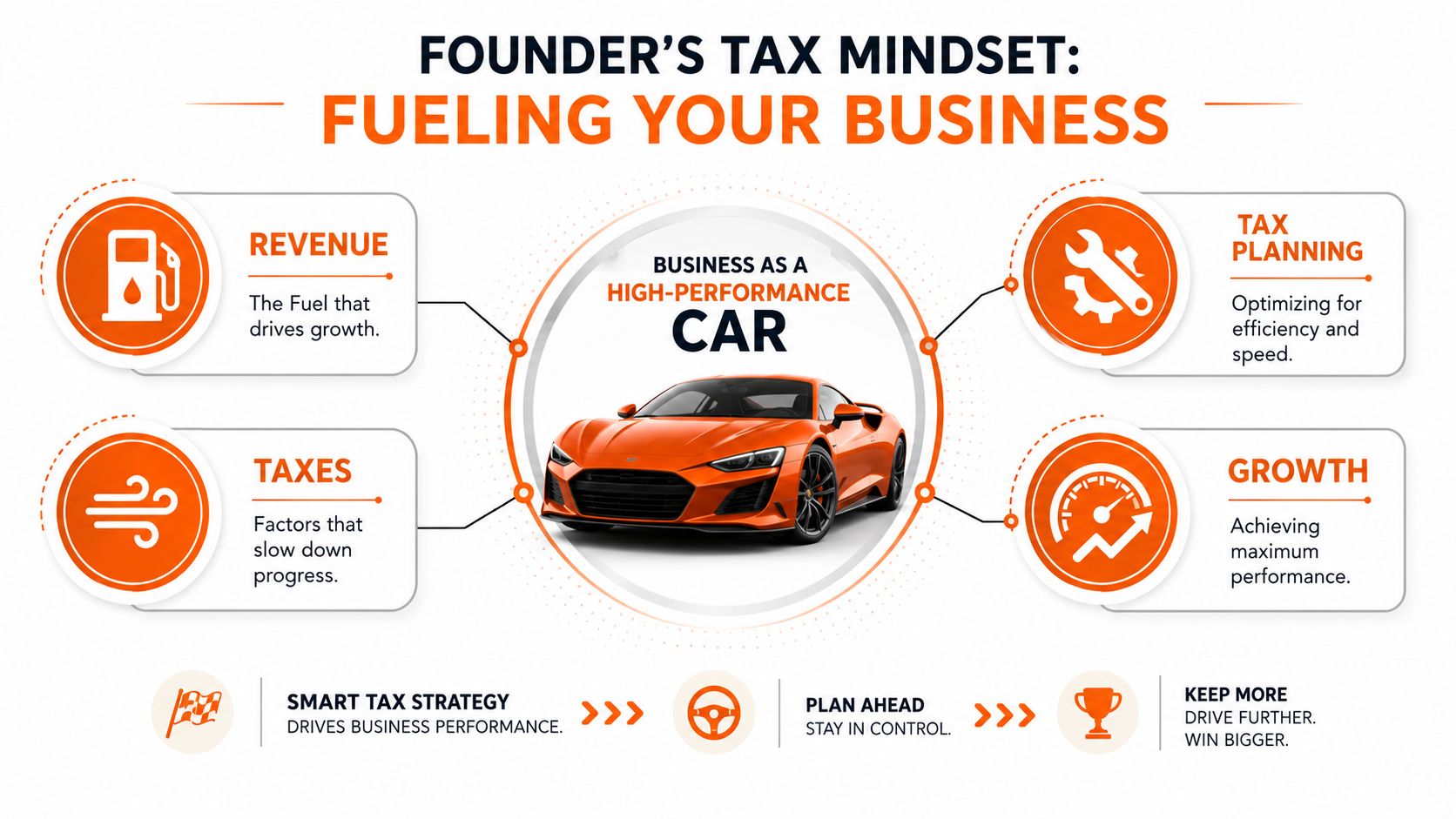
Think about your company like a tuned performance car.
Revenue is the fuel. Growth is speed. Taxes are friction and drag. Business tax planning is the tuning work that makes the same engine go farther. You're not breaking the rules of physics. You're building a cleaner machine.
A lot of founders act like tax planning is something only big companies do. That's backwards. More than 18 million enterprises worldwide actively utilize tax advisory and compliance services to deal with complex rules, according to Market Growth Reports. That tells you this isn't exotic. It's normal business hygiene.
The three levers I care about
I keep it to three buckets.
Structure
Your entity choice changes how money gets taxed before you ever talk about deductions. An LLC, an S-Corp election, and a C-Corp are not cosmetic choices. They change how much friction your business creates.
If you get this wrong early, you can still fix it, but fixing it later feels like rebuilding the car while driving on the Kennedy.
Deductions and credits
These are the legal ways you reduce taxable income or offset tax. Founders often focus on obvious expenses like software or rent. Fine. But the bigger wins often come from startup cost rules, research credits, and hiring-related credits if you qualify.
Timing
Timing is where founder instincts can help. When does income land? When do you incur expenses? What can you accelerate? What should wait? Good timing doesn't make taxes disappear, but it can stop you from paying earlier than necessary.
Taxes are one of the few expenses where bad timing alone can cost you money.
What I want you to optimize
Don't chase “lowest tax bill” in the abstract. Chase more reinvestable cash.
That's a better founder lens. More after-tax cash means more shots on goal. You can buy inventory before a stockout, test a new creative angle, hire a better operator, or survive a rough quarter without panic.
Here's the simple way I frame it:
- Fuel in: Revenue
- Drag out: Taxes
- Tuning tools: Structure, deductions, timing
- Result: More cash left to build
If you keep that picture in your head, tax decisions get easier. You stop asking, “What form do I file?” and start asking, “What setup leaves me with more clean cash and less chaos?”
Choosing Your Business Structure Before It Is Too Late
This decision hits harder than most founders think. Your entity is like the foundation under a house. You can renovate the kitchen later. You do not want to jack up the whole building once furniture is inside.
In the first three years, I'd focus on three paths: LLC, S-Corp, and C-Corp. Anything else is usually a distraction for a typical startup or ecommerce founder in Chicago.
The quick comparison
| Factor | LLC | S-Corp | C-Corp |
|---|---|---|---|
| Setup feel | Simple | More admin than LLC | Most formal |
| Tax treatment | Pass-through by default | Pass-through with payroll rules | Separate corporate taxation |
| Founder payroll | Usually owner draws | Salary plus potential distributions | Salary through payroll |
| Investor fit | Fine for many bootstrapped businesses | Less ideal for many venture setups | Usually the path for venture-backed startups |
| QSBS potential | No | No | Yes, if the company qualifies |
| Headache level | Lowest | Medium | Highest |
That table is the rough map. Now let me translate it into founder language.
LLC is the default for a reason
If you're very early, an LLC is usually the easiest way to get moving. It gives you liability separation if you respect the entity and keep business and personal finances separate. It also keeps admin lighter while you're still proving the thing works.
For many founders, that simplicity is worth a lot in year one.
But simplicity has a catch. Once profit starts getting real, the default tax treatment can become expensive. That's when you should revisit the structure instead of staying on autopilot because “it's worked so far.”
S-Corp is often the practical move for a profitable founder
For a lot of bootstrapped service, agency, and ecommerce founders, the S-Corp election is where the conversation gets serious. You still keep a relatively lean structure, but you now have payroll requirements and more compliance.
That hassle can be worth it if your business is consistently profitable.
I'm not going to invent a magic threshold or toss out fake savings numbers. I'll say this plainly: if your business is throwing off meaningful profit and you're still taking everything as plain LLC income, you should have an S-Corp conversation now, not next spring.
If you want a clean legal overview of the tradeoffs, this guide for small business owners is a solid companion read.
C-Corp is the right choice for some founders, not all
A C-Corp has more paperwork. More formality. More moving parts. That scares people off, and sometimes it should.
But if you plan to raise venture money, issue startup equity, or build for a future sale where stock treatment matters, a C-Corp can make sense early. The biggest reason many founders care is QSBS.
Here's the part people miss. You must file the 83(b) election within exactly 30 days of receiving founder shares to start the 5-year holding clock for Qualified Small Business Stock eligibility, and missing that window by even one day can cost you the ability to exclude up to $10 million in gains from federal taxes when you sell, as explained in this founder tax strategy guide.
That rule is brutal. It's like getting one boarding pass for a flight that might save you a fortune later. Show up late and the plane leaves without you.
If you're setting up a C-Corp and issuing founder stock, put the 83(b) deadline on your calendar the same day you sign.
My blunt recommendation
Use this filter:
- You're testing an idea or staying small for now: LLC is usually fine.
- You've got steady profit and want cleaner tax treatment: look hard at an S-Corp election.
- You want venture money, startup equity, or QSBS upside: start with a C-Corp and handle founder paperwork immediately.
Founders waste time searching for the “perfect” entity. You don't need perfect. You need one that fits the next few years and doesn't punish you for growing.
Common Deductions and Credits Most Founders Miss
A Chicago founder spends $18,000 before the first real customer shows up. Prototype work, lawyer fees, supplier trips, contractor code, maybe a coworking desk in Fulton Market. Then tax season hits and half of it gets dumped into “miscellaneous” or missed entirely.
That is how founders overpay in years one through three.
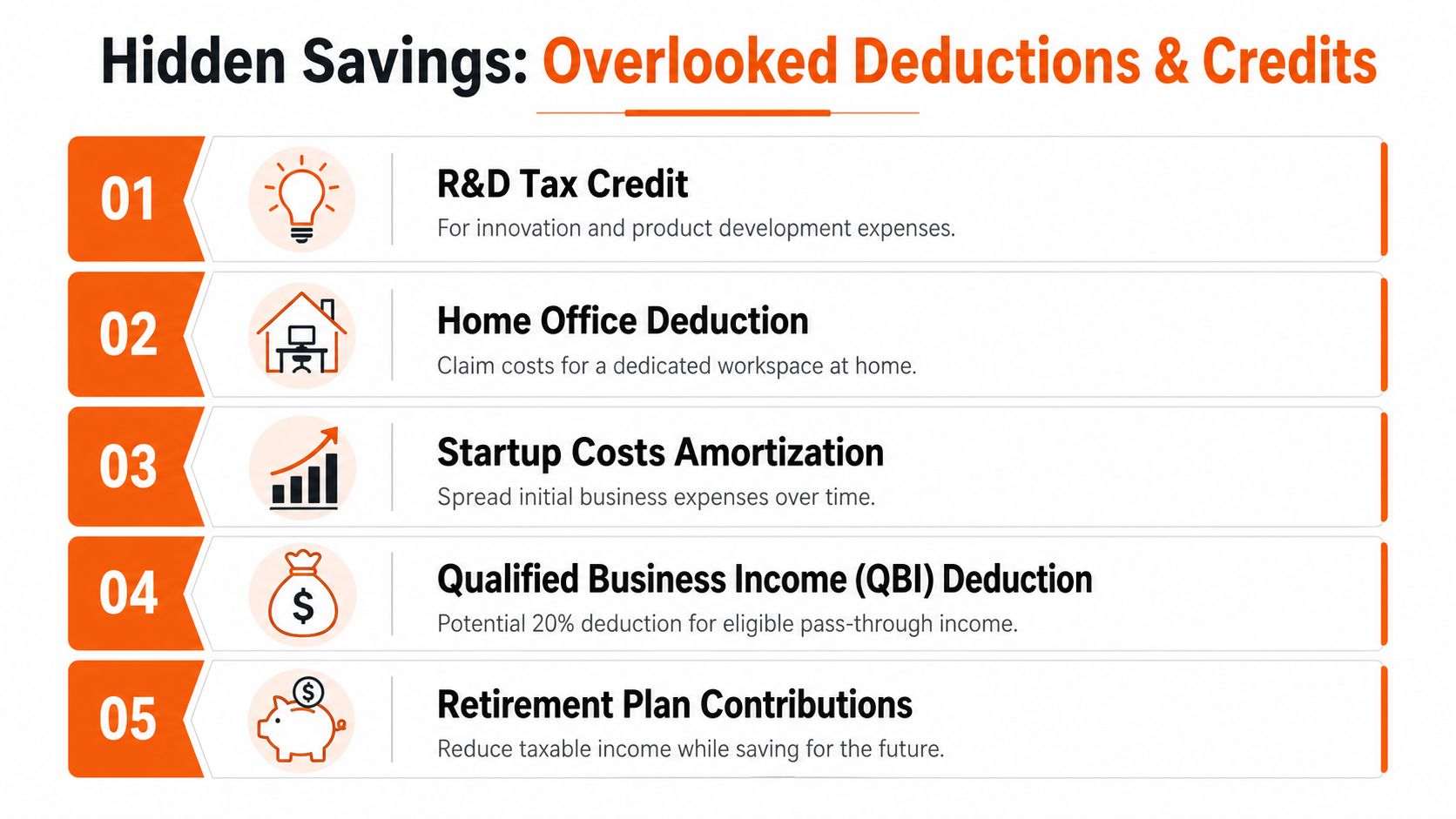
The easy deductions are obvious. Software, ads, bookkeeping, laptops. The better savings usually sit in the boring corners. Pre-launch spending. Technical work. Hiring paperwork. If you are building in Chicago or anywhere in the Midwest, that 80/20 matters because your first few years are usually cash-starved and messy. You do not need fancy tax theory. You need to stop missing the buckets that move the number.
Startup costs count sooner than many founders think
A lot of first-time founders spend real money before the business officially opens. Market research. Travel to meet suppliers. Legal setup. Early formation work.
You cannot classify all of that any way you want. But there is a useful first-year break. You can deduct up to $5,000 of startup costs and up to $5,000 of organizational costs in the first year, subject to phaseout rules, while the rest is generally amortized over 15 years, as explained in this startup tax planning breakdown.
That rule matters most when cash is tight, which is exactly when early-stage founders feel every dollar.
What I'd do
- Build a pre-launch folder: Save formation invoices, research receipts, and travel records before opening day.
- Tag expenses clearly: Do not throw everything into “other expense.”
- Separate startup from organizational costs: Your tax preparer cannot fix sloppy records after the fact.
- Write short notes on odd expenses: “Supplier meeting in Milwaukee” beats a mystery credit card charge six months later.
The R&D credit applies to more startups than founders think
If your team is writing code, testing prototypes, improving a process, or trying to solve technical uncertainty, ask about the research credit. Founders hear “R&D” and picture giant pharma companies. That is a mistake.
The IRS says qualifying research must meet a four-part test tied to permitted purpose, technological in nature work, elimination of uncertainty, and a process of experimentation, as described on the IRS credit for increasing research activities page. For eligible small businesses, that credit can also be applied against payroll tax instead of income tax, which is often the only version that matters in the first few years.
That is where this gets practical. A startup with engineers on payroll may have real credit value even if it is not profitable yet.
If you are paying developers to solve hard technical problems and nobody has asked about the R&D credit, you have a hole in your process.
Hiring credits get missed because founders never ask early enough
There is also a hiring angle. If you hire people from certain groups that face barriers to employment, your company may qualify for the Work Opportunity Tax Credit. The U.S. Department of Labor explains that employers must generally submit Form 8850 to the state workforce agency within 28 days after the employee starts work, which is the kind of deadline founders miss because nobody mentions it during hiring, according to the Department of Labor WOTC overview.
The credit should never drive the hire. But if you were going to make the hire anyway, missing the paperwork is just lighting money on fire.
Midwest founders miss this all the time because hiring moves fast, the office manager is part-time, and everyone is focused on filling the role.
Do not mix up income tax planning and ecommerce tax problems
If you sell online, keep your categories straight. Income tax deductions are one issue. Sales tax, nexus, and multistate compliance are a different beast entirely. Read this practical guide on the taxation of electronic commerce if ecommerce is part of your model.
If you like comparing how other markets treat expense categories, this 2026 guide to UK tax deductions is a useful contrast point, even though your U.S. filing rules are different.
My founder checklist for missed savings
- Pull every pre-launch expense into one review folder and sort it before year-end.
- Ask whether product and engineering work meets the IRS research test instead of assuming it does not.
- Build hiring tax forms into onboarding so credits do not die on day 29.
- Keep documentation while the work is happening because memory is a terrible bookkeeping system.
The tax code has plenty of traps. It also rewards founders who keep clean records and ask the right questions early. In your first three years, that discipline matters more than any clever strategy.
Your Year-Round Tax Planning Calendar
A lot of Chicago founders learn tax planning the hard way. March arrives, the bill hits, cash is tight because payroll, rent, and software already ate the checking account, and now the IRS wants its cut. That mess usually starts in January, not April.
Run taxes like you run inventory. Check levels early, refill on schedule, and do not act surprised when the shelf is empty.
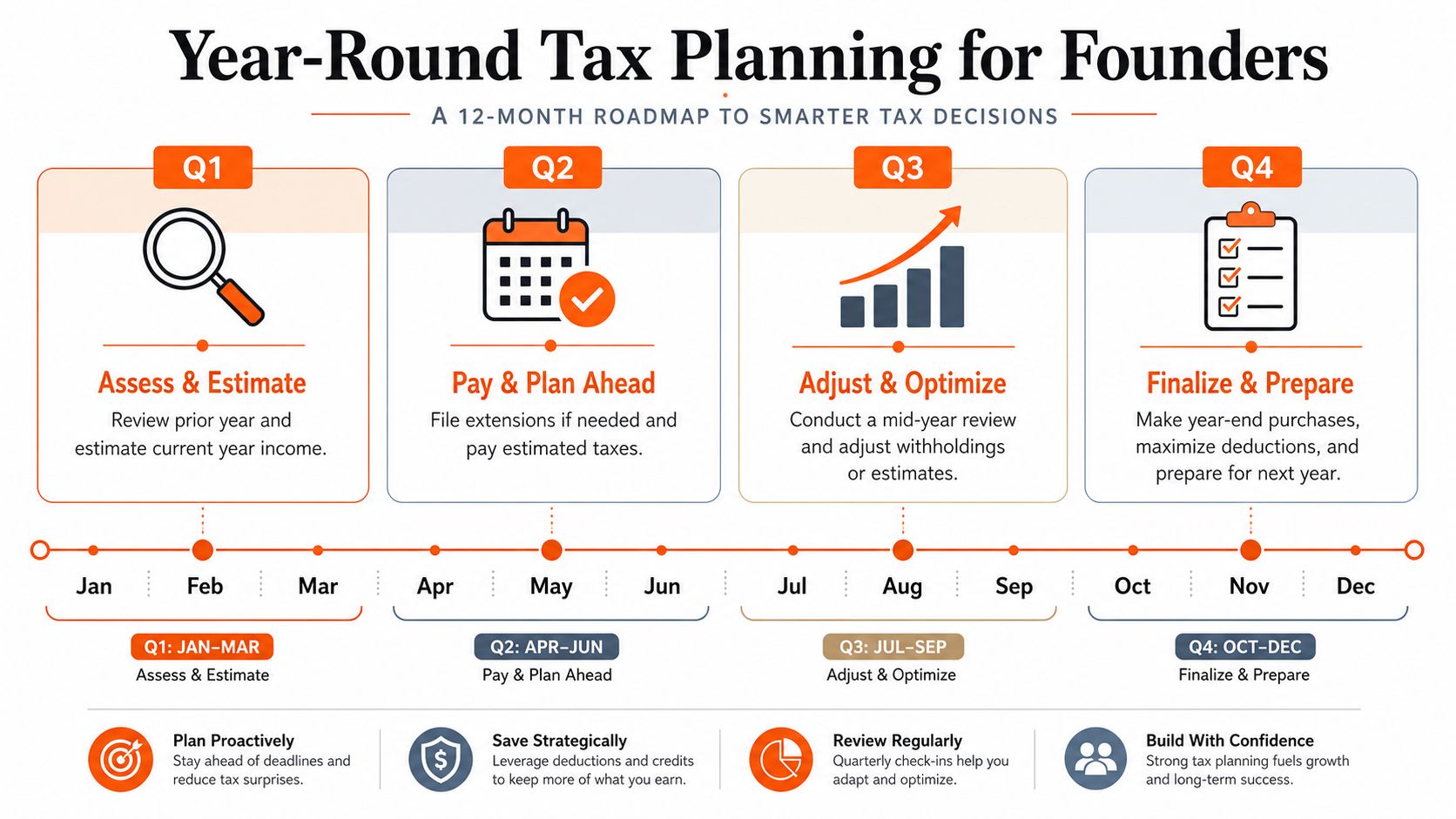
For Midwest founders in years one through three, the calendar does not need to be fancy. It needs to be repeatable. Here is the 80/20 version.
Q1 clean setup and clear estimates
First quarter is where you prevent stupid problems.
Start by locking your entity choice and making sure your bookkeeping matches reality. If you planned an S-Corp election, handle it. If last year's books are still messy, clean them up before you start stacking another year on top.
Then make one honest forecast. Revenue, major costs, payroll, owner pay, and expected profit. It does not need to impress anyone. It needs to help you stop underpaying taxes for six straight months.
If you operate across borders or just like seeing how other markets frame deductions, this 2026 guide to UK tax deductions is useful for comparison, even though your U.S. filing rules are different.
Q2 pay and adjust
By Q2, you have enough data to stop guessing.
The IRS expects businesses to stay current during the year, not settle up whenever cash feels available. So make estimated payments on schedule, and move the tax money out of your operating account the moment it becomes obvious you owe it. If you leave tax cash sitting next to regular cash, founders spend it. Every time.
Keep this quarter tight:
- Send estimated payments on time
- Compare actual profit to your Q1 forecast
- Move a set percentage of collections into a tax savings account
- Flag any jump in contractor, payroll, or software spend that changes your margin
One sentence I repeat a lot. Profit on paper is not cash in the bank, and tax due is not optional.
Q3 midyear reality check
Q3 is your correction quarter.
By then, your business has shown its real shape. Maybe sales are stronger than expected. Maybe margins are thinner because customer acquisition got expensive. Maybe you hired faster than planned. This is the moment to revisit your estimate, adjust payments, and fix recordkeeping before year-end chaos starts.
Ask blunt questions:
- Are owner draws or salary creating a tax problem?
- Did a new hire, contractor, or benefit add reporting work you have not handled?
- Are reimbursements, travel, and software charges still being booked cleanly?
- Are receipts trapped in inboxes, texts, and personal cards?
If the rest of your money system is loose, tax planning stays loose too. Read this guide to financial planning for startups and tighten your cash flow process while you still have time to fix it.
Q4 use timing on purpose
December is where founders either save money on purpose or donate money through neglect.
If income is running higher than expected, review whether it makes sense to pull needed expenses into the current year. If next year looks stronger, avoid random year-end spending just to feel productive. Timing matters, but fake deductions are still fake. Buy what the business needs, document it, and make the decision before the last week of the year.
Book a short year-end tax meeting before the holidays. One hour is enough to review profit, owner pay, estimated payments, payroll issues, and any big purchases you are considering. Waiting until January turns planning into cleanup, and cleanup costs more.
When to Stop DIYing and Hire a Pro
You file your own taxes the first year. Fine. Then year two hits. You add a W-2 employee in Chicago, start selling outside Illinois, maybe raise a small round, and suddenly taxes stop being a cheap software problem and turn into a penalty problem.
That is the line.

The signs are easy to spot
Hire a tax pro when one of these shows up:
- Profit starts showing up consistently: once the business throws off real money, bad entity setup, missed elections, and sloppy owner pay choices start costing more than the fee to get expert help.
- You hire your first employee: payroll brings filings, deadlines, and rules that punish casual mistakes.
- You operate across state lines: Midwest founders hit this earlier than they expect. One contractor in Indiana, a customer footprint in Wisconsin, or remote work in Michigan can create filing headaches fast.
- You raise money or issue equity: founders mess this up all the time, then pay lawyers and accountants later to clean it up.
- You may qualify for credits: if you build software, products, or technical processes, get a real review before you leave money on the table.
A good example is the startup R&D payroll tax credit. The IRS lets qualified small businesses apply research credit dollars against payroll taxes, and recent law expanded that benefit. Read the IRS guidance on the Qualified Small Business Payroll Tax Credit for Increasing Research Activities. If that might apply to your company, do not guess.
What a good CPA should help you do
Beyond filing forms, a good CPA helps you make decisions before they harden into expensive mistakes.
For a Chicago founder in the first three years, that usually means:
- catching elections and deadlines while they are still fixable
- setting up owner salary or draws the right way
- aligning bookkeeping with the tax return so April is not a rebuild project
- telling you which deductions will survive scrutiny
- keeping your entity choice aligned with how the business is growing
- flagging Illinois and multi-state issues before they turn into notices
Use one simple gut check. If tax season feels like an annual ambulance ride, you outgrew DIY months ago.
My opinion
Founders hang on to DIY too long because doing everything yourself worked at the start. That instinct helps you survive the first year. It also creates dumb tax bills in years two and three.
Tax work is like plumbing behind the walls. You can swap a faucet yourself. Once water is running through the whole building, guessing gets expensive fast.
If your startup has payroll, profit, equity, or multi-state activity, hire the pro.
If you're a kind, ambitious Chicago founder who wants honest help from people building businesses, Chicago Brandstarters is worth your time. It's a free vetted community where founders share real tactics, real mistakes, and real support in small private dinners and an active group chat. If you're tired of fake networking and want better people around you while you build, that's a strong place to start.
Leave a Reply